Imagine you’re in a car accident and you hit your head during the crash, leaving you feeling woozy and sensitive to light and sound. Or maybe you’re playing sports and took a big hit and now you’re drowsy and have trouble balancing. You’ve heard of concussions, but don’t really know what they are or what to do about one.
Don’t find yourself in a situation like this without the knowledge you need to respond to a possible concussion properly. Keep reading to find out what concussions are, what to do if you suffer from one and what your legal options are.
What is a Concussion?
A concussion is a type of traumatic brain injury caused by a blow or jolt to the head that causes the head and brain to move quickly backward and forward. The speed of the movement causes the brain to move in the skull causing chemical changes in the brain and can cause stretching and damaging brain cells.
Concussions can make the sufferer fall unconscious, but not always.
The most common way to suffer from a concussion is from a fall, but concussions are also common when playing contact sports like football or soccer. They can also occur from car accidents or workplace accidents.
Symptoms of a Concussion
Concussions symptoms can be subtle, short-term or in some cases delayed. But sometimes symptoms can be just the opposite—lasting for weeks and creating major problems in a person’s life.
Watch out for symptoms in yourself after a head injury, but it’s also important to have other people keep an eye out for symptoms you may not notice.
Headache
Ringing in the ears
Nausea and/or vomiting
Fatigue or drowsiness
Blurry vision
Dizziness, confusion or even amnesia regarding the event
Slurred speech
Appearing dazed
Delayed response to questions or forgetfulness
Symptoms that occur days later can be a little different. But if things like trouble sleeping, taste or smell changes, light and noise sensitivity, personality changes or concentration or memory issues start cropping up, it may also be a sign of a concussion.
Keches Law Trial Attorney Sean Kiely says most people with a traumatic brain injury have a general feeling that they aren’t well.
“Some people feel tired or drowsy, some people experience sensitivity to noise and light,” he says. “If you’ve suffered a traumatic brain injury, over 95% of people experience headache-like symptoms.”
What Are My Legal Options with a Concussion?
You have various options legally, depending on how your head was injured. If it happened through the negligent behavior of another person, you may have a case for a personal injury lawsuit. If the injury came at work, while performing typical work functions, you may be eligible for workers’ compensation.
“When you’re dealing with long-term pain, it affects every aspect of your life,” Kiely says.
Pain and suffering can’t be used for workers’ compensation claims, Kiely says. But if a client is looking for a personal injury settlement, it’s crucial to show how the injury has affected their life.
“It’s about trying to compensate the individual as best we can so they can get on with their life,” he says. “It’s about getting them the justice they deserve.”
When Should You Return to Work after a Concussion?
After suffering a concussion, you may need to take time off work, athletics, or other physically or mentally straining obligations. In this situation, make sure to listen to the doctor’s orders and to follow up with a doctor’s note for wherever it may be required.
Common medical advice when recovering from a concussion includes:
Avoid intense lighting or excessive noise.
Don’t look at computers, cell phones, and TVs for any extended period of time.
Exercise can put you at risk of a slow recovery through unnecessary movements. Also through the increase of your blood flow to the brain which may spike headaches.
And of course, work with your medical provider to treat your injury appropriately.
Sometimes workers who suffer concussions feel obligated to rush back to work as soon as they start feeling better. This is due to guilt or even pressure from their employer. We can’t emphasize enough that it’s important to rest for as long as your doctor recommends to avoid long-term complications or further injuries as a result of returning to work too soon.
If You’ve Suffered a Concussion, Keches Law Group Can Help
Reach out to our skilled and experienced workers’ compensation lawyers and personal injury lawyers if you suffered a concussion at work or if your head injury was due to the negligence of another person.
Do you ever need to work outside during hot weather? Workers exposed to extreme heat are threatened by heat stress, a condition including multiple heat-related illnesses such as heat stroke, heat exhaustion, heat cramps, and heat rash.
Injuries are also a symptom of extreme heat. Sweaty palms, fogged-up glasses, and dizziness brought on by heat can all lead to dangerous accidents on the job.
Read on to learn more about heat stress symptoms and prevention and find out how suffering a heat-related injury or health issue like heat stroke, heat exhaustion, heat cramps or heat rash may lead to a valid workers’ compensation claim.
“Heat stress” or “heat illness” are blanket terms including conditions like heat stroke, heat exhaustion, heat cramps, and heat rash.
Before trying to prevent or treat extreme heat conditions, you need to learn what they are and how they differ:
Heat Stroke
The most severe heat-related injury is heat stroke. When experiencing heat stroke, your body’s temperature will rise rapidly, but won’t sweat. Which means you won’t be able to cool down. If left untreated, heat stroke can be fatal or cause permanent disability. Symptoms of Heat stroke include confusion, coma, hot and dry skin, profuse sweating, seizures, and high body temperature.
Heat Cramps
Heat cramps are a real possibility for people who are very active in hot weather. Usually caused by lots of sweating, heat cramps are also the result of a loss of water and salt. If salt levels in muscles get too low it can cause painful cramps. Symptoms of heat cramps include Muscle cramps, pain, or spasms in the abdomen, arms, or legs.
Heat Exhaustion
Heat exhaustion happens when the body has lost too much water and salt and is usually caused by excessive sweating. Although heat exhaustion sounds similar to heat cramps, it is a more serious condition. Specific groups are more susceptible: the elderly, those with high blood pressure, and people who work in extreme heat. Heat exhaustion symptoms include headache, nausea, dizziness, weakness, irritability, thirst, heavy sweating, elevated body temperature, and decreased urine output.
Heat Rash
Excessive sweat can also cause heat rash, also sometimes called prickly heat. Heat rash is an irritation of the skin marked by red clusters of pimples or small blisters in areas such as the neck or upper chest.
Who’s Likely to Face Heat Stroke, Heat Exhaustion or Other Heat Stress Issues?
People who work in some professions are more at risk of experiencing heat stress conditions like heat rash, heat cramps, heat stroke or heat exhaustion. Firefighters, bakery workers, farmers, construction workers, miners, boiler room workers, factory workers, and landscapers are particularly susceptible.
Along with workers frequently exposed to heat, other groups may be at higher risk of heat-related illness and injury like heat stroke or heat exhaustion. Being over age 65 or overweight can make someone more susceptible to extreme heat, which not only can increase risk of suffering a heat-related injury or health issue, but it can also lead to more severe symptoms. Certain preexisting medical conditions like heart disease or high blood pressure and even some medications may also increase likelihood of experiencing heat stress.
During warmer months, employees who may not usually be in danger of experiencing a heat-related injury can become more exposed to the potential hazards of hot working climates.
It’s vital to take preventive steps while working in hazardous temperatures and seek medical treatment or first-aid when you recognize potential symptoms of heat stress.
What Can I Do to Prevent Illness and Injury During Hot Weather?
Fortunately, whether you work a high-risk job, have a condition that makes you more vulnerable, or are preparing to work in hotter than normal weather conditions, heat stress prevention is simple.
Train your employees. It’s important employees know how to handle heat hazards. Firstly, make sure employees know if they are facing any job-specific threats. Learning about the different heat-related illnesses and how to recognize them in themselves and other workers could end up preventing disaster. Employers should also explain how to contact emergency medical services and perform first-aid.
Keep an eye out for each other.Preventing heat stress is best accomplished in teams or via a buddy system. While working in the heat, look out for signs of heat-related illness or injury in yourself and your coworkers.
Water. Rest. Shade. The best heat stress prevention technique is to hydrate and rest. OSHA’s heat illness prevention campaign “Water. Rest. Shade.” explains it best. Drinking when you’re thirsty isn’t enough; OSHA recommends drinking one cup (8 ounces) of water every 20 minutes while working in the heat. Employers should provide cool water and, for longer jobs (those that last over 2 hours), drinks with electrolytes such as sports drinks. Employers should also enforce frequent breaks, preferably in a cool or shaded area such as an air-conditioned vehicle or under a tent.
Courtesy of Lindsay Flathers Photography (lindsayflathers.com)
If you’re the owner of one of the almost 12 million registered boats in the United States, ahoy! Boating is a great way to enjoy the natural world around us — especially when it’s hot or sunny! The cool breeze and fun with friends and water make for a delightful day.
But before you set sail or hit the gas, make sure you’re operating your boat safely. Read on to learn some things everyone should know about boat safety—and some other tips that are less common knowledge!
Is a Boating Safety Course Worth it?
Yes. A free boating safety course in Massachusetts is a little time intensive, but it’s totally worth it. The class, which is open to anyone 12 and older, takes multiple days and 10-12 hours to complete!
A boating safety class may sound like a hassle, but it could be the difference between a nice day on the boat and you or your passengers suffering a boating injury or even becoming a casualty in a boating accident.
More than 4,000 boating accidents were reported in 2022, resulting in 2,222 injuries and 658 deaths. So while the taking the class might require a little extra time and effort, going into your boat trip armed with boating safety knowledge makes things safer and less stressful for everyone.
“Going through a boating safety course is very important,” says Chad Hunter, Plymouth, Massachusetts Harbormaster. “A lot of people are unaware of the risks and being on the water—the environment is ever-changing.”
If you’re looking for a supplemental option, Boat On Course has a great library of content with essential boat safety tips. Check out their recommendations on what to bring for Essential Boating Safety Gear below!
Make a Boating Safety Checklist
Before you’re ready to climb aboard and head out for the day, it’s important to review your boat safety checklist to make sure you’ve addressed any possible safety risks. Read on for six key components to include on your boating safety checklist.
Check out the weather forecast. This might seem obvious, but when you plan a trip on a boat, make sure the weather will be good for boating. The forecast may have been sunny when you first planned your trip, but make sure the weather report is holding up that day.
File a float plan. Someone needs to know where you’re going, who’s with you, and what you’re bringing, as well as your boat’s registration information. This ensures that someone will have key details to share with first responders if you get lost, stuck, or don’t return from the trip.
Make sure you have life jackets. Everyone on board your boat should have a properly fitting life jacket. Kids are required to wear a life jacket at all times on boats and our furry friends should have them too!
“The best life jacket is the one you will wear,” said Peg Phillips, executive director of the National Safe Boating Council. “Whether you’re going fishing or just enjoying a ride on the boat, make sure you’re prepared for the adventure by wearing a life jacket and knowing how to use required safety gear.”
4. General safety items. While you’re getting the life jackets, make sure you bring other boat safety equipment like a fire extinguisher, a navigation system or flotation devices.
Dress appropriately. Always make sure you have appropriate clothing for being out on the water! No matter how nice the forecast looks, it’s always a good idea to bring a sweatshirt, a waterproof jacket, sunglasses, and a hat to make sure you’re covered in case of unpredictable weather.
Take extra precautions. Get a free vessel check through the U.S. Coast Guard, and share safety features and operating instructions with at least one of your passengers so they’re prepared to help in case of an emergency. Not only can it get you out of a sticky situation faster, it’s important to have backup in case the boat operator is injured or otherwise incapacitated during the trip.
“Prepare for a great boating season by inspecting your boating safety gear and commit to providing comfortable life jackets for all your passengers to wear every time you go boating,” said Phillips.
Safety Tips For Your Boat’s Maiden Voyage
Whether you’re a sailor or a speedboat lover, boating is a way of life for a lot of people.
But everyone has to start somewhere, so make sure to prepare properly for your first boating trip. Even if you’ve taken your safety course and run through your boat safety checklist, don’t go 0 to 60!
“Most people start out with smaller boats,” Hunter says. “It’s not like a car, you can’t just park and walk away. You stop, but it continues to move.”
Take it easy. The first time you head out on the water, you should overemphasize safety. Prepare in advance for what you’re going to do, and avoid the temptation of overdoing the activities. Instead of bringing water skis, fishing gear and a scuba suit, talk to your boating party and agree on just one activity to ensure everyone has a safe experience.
Other Important Boat Safety Tips
Don’t drink when at the helm. Whoever is operating the boat has the safety of everyone else aboard in their hands. If the boat’s operator has been drinking than everyone is at risk.
Beware of Boater’s Hypnosis. If you’re the one operating the boat, the risks of drinking alcohol are even greater due to a phenomenon called Boater’s Hypnosis. The combination of noise and vibrations, along with the sun, glare and wind on the open water can make a boat operator slow to react, mirroring the effects of drinking. Adding alcohol to the equation can lead to further impairment, which is a recipe for disaster.
“There are a lot of added stressors that your body is going through,” Hunter says. “It only enhances intoxication. You should dedicate a captain that’s not drinking when you go out on a boat.”
Know how to navigate. Most waterways have charts prepared by the government or locally. Learning how to read charts is extremely helpful in keeping you and your fellow passengers safe on the water.
Use your engine cut-off switch. Also known as a safety lanyard or an engine kill switch, the engine cut-off switch is designed to stop the boat’s engine if the operator is thrown from the helm. This safety feature is essential for motorboat operators, especially when turning at high speeds or navigating choppier waters.
Have a Boating-Related Injury? Keches Law Group Can Help!
It’s hard to get anything done when your head is pounding. Add in common migraine symptoms like vision disturbances, nausea, and sensitivities to light or noise, and you’ve got a recipe for disaster.
Did you know that Thomas Jefferson suffered from severe headaches that many historians think were likely migraine episodes – he even dealt with one right before writing the Declaration of Independence!
His plight isn’t unusual. About 12% of Americans are affected by the intense pulsating headaches which can last anywhere from 4 hours to multiple days and can reoccur multiple times per week in some cases. Often passed down hereditarily, migraines are considered a disability when chronic.
WHAT’S A MIGRAINE – OR A HEADACHE FOR THAT MATTER?
Headaches are a common pain that most people deal with at one point or another, if not regularly. There are several types of headaches, and they aren’t dangerous, but they can be a symptom of a more dangerous condition. A migraine is a very severe form of a headache.
Migraine is a common, but severe neurological disease with a wide range of symptoms. There are several types of migraine episodes, but they all cause intense head pain, on one side or both, and often come with nausea, sensitivity to light, sound or smells. Women are three times more likely to experience a migraine episode than men.
Migraine episodes usually come suddenly, but sometimes sufferers get a warning through subtle changes like constipation, mood changes or food cravings. Then immediately before one comes on, an “aura” can foreshadow a migraine episode. Auras can present as bright flashing spots or lights in the sufferer’s vision, seeing wavy or jagged lines, speech changes and more.
HOW DO I IDENTIFY AND COMBAT MIGRAINE TRIGGERS?
Migraine episodes can be caused or intensified by a variety of different factors called “triggers,” and they can vary quite a bit from person to person. Common triggers include sensitivity to chemicals or preservatives in food, caffeine, daily use of pain-relieving medication, light, barometric pressure changes, not drinking enough water, overexertion and changes to regular sleep pattern.
One of the most common triggers by far is stress. During stressful situations, certain chemicals in the brain can cause a “fight or flight” response and then other emotional reactions like anxiety or worry actually make the problem worse by increasing muscle tension and dilating blood vessels.
After you learn your triggers, adjusting your lifestyle to eliminate them is a good start to attempting to curb your migraine episodes. If that strategy doesn’t stop the pain from coming, talk to a doctor about preventative medication. That way you can stop the headache before it shows up. You can also take medicines to combat the headache when it has already begun.
If none of that works, other methods can slow the pain. Rest in a quiet, dark room and switch between hot and cold compresses on your head. There are many forms of medication or therapy techniques doctors may advise for a migraine or chronic headache sufferer to try. Ask a doctor if you feel medication is right for treating your headaches.
HOW DO MIGRAINES AND HEADACHES AFFECT WORK?
Migraines send warning signals in the form of symptoms and auras. What if someone is at work when they realize a migraine is coming soon?
Try medicine.The first step to take is to find a quiet spot away from your work station, take preventative medication and relax. Wait for the headache to go away and return to work. If it doesn’t work, it might be time to consider going home.
Head home. Some people who regularly get migraines know a certain symptom will signify that it’s time to go home and try sleeping it off. If the medication didn’t solve the problem and symptoms are increasing or intensifying, it is probably time to go home before it gets any worse. If someone waits too long and the migraine is severe enough, it may be wiser to ask a family member, friend or coworker for a ride home or take public transportation, rather than driving impaired by the headache.
Sleep and get ready for a calm next day. If the migraine goes away after rest and sleep, then prepare to go to work but do not try to make up for the time missed. “When a patient misses a day because of a migraine or they’re behind because of a migraine, they get more anxious and concerned about finishing what they need to finish, and that doesn’t help the whole process,” said Dr. Merle Diamond, director of the Diamond Headache Clinic in Chicago.
Talk to your employer. If migraines are a regular problem you are dealing with, make sure your employer or HR representative knows your triggers and that there may be times when you need to go home. Advocate for yourself and make sure they know it won’t affect your work when unencumbered. Employers can support their migraine suffering employees by taking out bright lights or dimming the lights, asking the employee if they’d prefer to be moved to a more secluded or quiet area, make it clear you are flexible during an episode and by providing air-purification systems to reduce scents.
Want to be ready when a migraine episode begins? Make sure you have everything on your migraine checklist:
Bottle of over-the-counter headache medicine and prescription medication if you have it
Pair of sunglasses and ear plugs
Bottle of water
Tea bags or Instant coffee for the caffeine
Cold and warm packs (keep the cold one in the freezer)
Pair of headphones (if listening to music, audiobooks or podcasts soothes you)
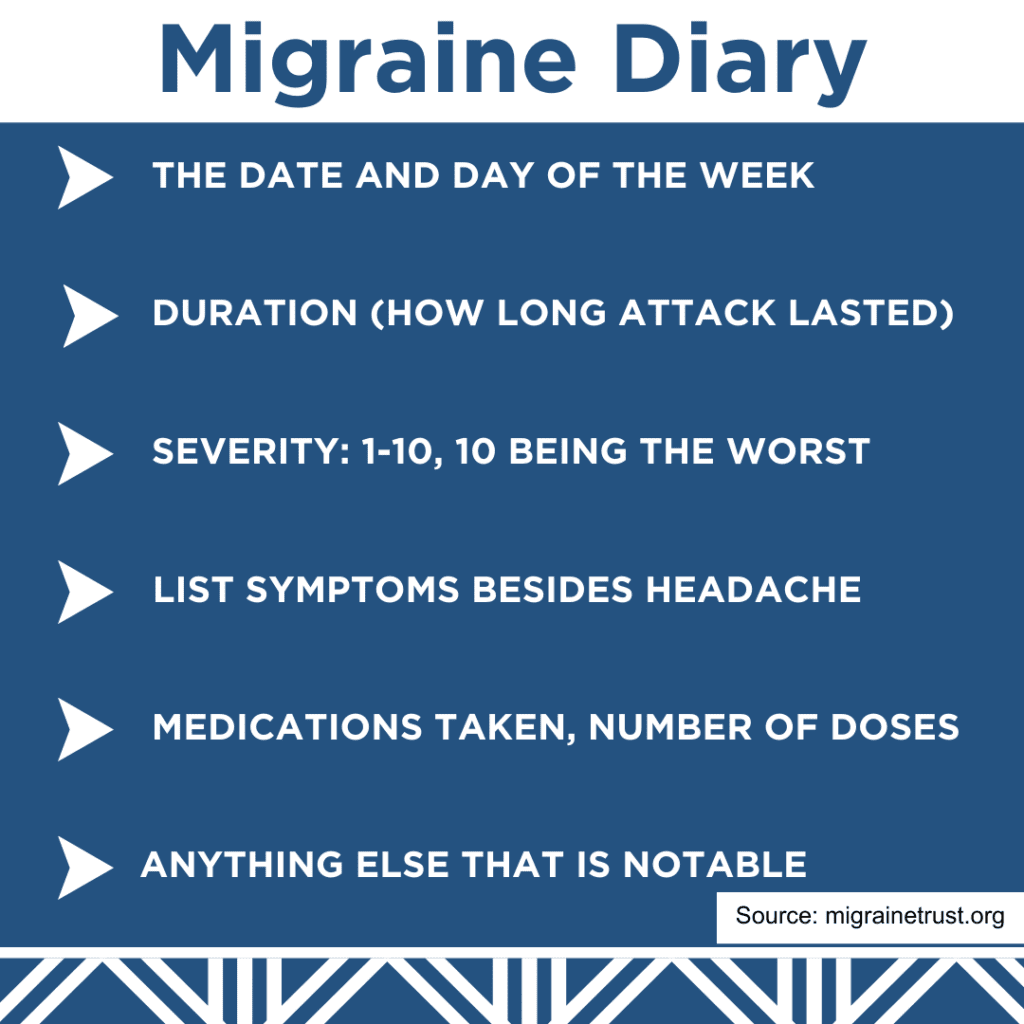
Migraine diary
Essential oils to dab on forehead or temples (lavender, peppermint, chamomile)
WHAT IF AN INJURY CAUSED MY MIGRAINES OR HEADACHES?
After suffering a traumatic brain injury, one of the most common symptoms is headache. Up to 90% of people with traumatic brain injuries report headaches and more than 30% of people report headaches that continue long after the injury occurs.
With about 1.4 million cases of traumatic brain injury occurring every year in America, headaches take on multiple forms after an injury. Stress headaches or cluster headaches as well as migraines and posttraumatic headaches can result from traumatic brain injuries. Keches Law Trial Attorney Sean Kiely said post-traumatic headaches act similarly to migraines.
“A migraine is considered a primary headache disorder. Whereas a Post-traumatic headache is a secondary disorder. They aren’t the same thing but they do have a lot of the common features,” Kiely says. “Things like light sensitivity, noise sensitivity, being nauseous, generally the symptoms that everyone associates with headaches are the same”
Kiely says nearly everyone who experiences a traumatic brain injury experiences a headache, but for some the effects are even worse.
“When somebody suffers a traumatic brain injury, oftentimes they will experience a headache in the immediate aftermath. It can range from up to 2/3 of those people will experience migraine-like symptoms up to a year after the injury,” he says. “With that being said, there are studies out there that suggest those who are susceptible to migraines prior to suffering a traumatic brain injury will experience an even worse effect of migraine-like symptoms after they suffer from a traumatic brain injury. It just exacerbates underlying problems.”
If a traumatic brain injury was caused by someone else’s negligence, recklessness or carelessness, then a personal injury lawsuit could be warranted.
“If a headache results in a disability from performing your job, or a modified job and it can be established that the symptoms are medically causally related to the injury sustained at work, the resulting disability may be compensable” she says. “For example, if a Court Officer is attacked by an inmate and suffers a head injury, with symptoms to include debilitating headache which prevent him/her from performing their job duties, this injury would likely be compensable under M.G.L. c. 152.”
However, Gray points out that the cause of the headaches must be work-related.
“If an individual suffers from migraine type headaches unrelated to any workplace injury and/or has actively treated for headaches unprecipitated by a work injury for years, the simple act of suffering a migraine at work generally would not be compensable,” she says.
In fact, Gray says workers’ compensation for headaches is a medical decision and will require a physician to relate the headaches to an event or series of events that happened at work. She says in some cases the physician also needs to distinguish the workplace headaches from a prior condition or treatment the employee had undergone.
All sick-leave and paid time off need to be used before disability is claimed. The other issue is that the person’s migraines need to qualify as a disability.
A disability is usually described as a condition, injury or illness that renders a person unable to do his or her job. If someone wanted to claim workers’ compensation for migraines, they would need to provide proof to the insurance company through documentation of their migraines.
Keeping a “migraine-diary” stating how long each migraine lasts and what symptoms develop is a good way to present evidence as proof, not to mention a good way to gather information for a doctor.
TURN TO KECHES LAW GROUP FOR HELP
Headaches and migraines are a harsh everyday reality for millions of people in America. If you are considering filing for workers’ compensation or a personal injury lawsuit, know that we are here to help and can guide you through the process.
Fans watch sports and support their favorite teams, play along with fantasy sports and feel the pain when their favorite athlete goes down with an injury. But what does the athlete do if they get hurt on the job?
In Massachusetts and a handful of other states, professional athletes can – and do – claim workers’ compensation benefits for injuries sustained during their careers.
Read on to learn more about how injuries during slam dunks, slap shots, touchdowns and home runs could lead to workers’ compensation.
Workers’ Compensation for Professional Athletes
If employees get injured or sick at work, workers’ compensation offers them medical expenses, lost wages, disability payments and even the cost to rehabilitate or retrain them. But what happens when your job involves body checks, first downs, or alley oops? Turns out it depends on the state.
Under Massachusetts law, an “employee” is every person in the service of another under any contract of hire, express or implied, oral or written.
In Massachusetts, workers’ comp benefits extend to professional athletes, recognizing that their careers come with extraordinary risks, and sometimes those careers can come to a sudden halt due to injuries suffered in the line of duty.
Whether these 800 professional athletes can receive workers’ compensation depends on the contract they have with their team.
In many instances, NFL contracts stipulate that if a player sustains an injury on the field, they will remain on the team with pay throughout their work-related injury.
This situation is what Massachusetts law is referring to when it excludes “persons employed to participate in organized professional athletics, while so employed, if their contracts of hire provide for the payment of wages during the period of any disability resulting from such employment” from classification as employees.
In these situations, workers’ compensation is not an available remedy.
Former Chicago Bears Running Back Matt Forte received a substantial settlement for injuries. In fact, since 2000, the Bears have shelled out millions to players like Forte, Brian Urlacher, Devin Hester and Charles Tillman. These claims typically involve injuries like neck issues, back problems, knee injuries, wrist ailments, and more.
It’s worth noting a critical difference between these cases and those involving head injuries. With acute injuries, such as a sprained ankle or a dislocated shoulder, team doctors can often pinpoint the moment in a game when the injury occurred. This clarity makes it easier to establish a direct link between the injury and the game.
However, not all NFL contracts contain such guarantees. If a team releases a player without pay following injury, they may be eligible for workers’ compensation and should consult with an experienced attorney to learn more about their rights and available remedies.
Legal Challenge Examples
Workers’ compensation for athletes is particularly complicated when it comes to head injuries. Some athletes have waged a legal battle to secure compensation for a range of injuries, including those linked to head trauma.
But workers’ comp claims related to head injuries can be an uphill battle. It’s hard to show that a head injury is directly related to play and former players have encountered mixed outcomes when seeking compensation for injuries tied to their careers.
Al Noga, who played for the Minnesota Vikings from 1988-1992, received a settlement from the team for orthopedic issues developed during his career in 2004. But when he was diagnosed with dementia in 2015, his claim was denied.
“Noga played for the Vikings from 1988 to 1992, but medical awareness of the connection between and among head injuries, possible concussions, and the potential long-term neurological effects of those events had not yet developed,” Justice Natalie Hudson wrote in the court’s opinion.
Originally, a compensation judge sided with Noga, but the Vikings appealed multiple times, and eventually the Minnesota State Supreme Court reached the decision to deny Noga Workers’ Compensation.
Meanwhile, between 2008-2015, 434 NHL players filed for and received workers’ compensation over injuries suffered during play. Of those players, 377 had suffered head injuries. All of these claims were filed in California because the state had a law in place until 2014 allowing players to file a claim if they believed their injury worsened while playing in the Golden State.
California eventually changed the law when it became clear athletes from out of state had essentially had California pay their workers’ comp because their state wouldn’t.
“We found that there were a billion dollars in claims that were being filled out by out-of-state workers against out-of-state employers and they all turned out to be professional athletes,” said Henry Perea, former California State Assemblyman.
But it wasn’t just NHL players. In fact, more claims were actually made by football and baseball players.
In Illinois, the Chicago Bears and other sports franchises have lobbied for a rule change that would restrict former players’ access to workers’ comp benefits, especially if they’ve sustained career-ending injuries. Teams fear the financial burden for years of payments and possible insurance hikes.
The rule would mean benefits would only be granted to players aged 35 or younger and only for 5 years after the injury occurred.
Why Would a Professional Athlete Need Access to Workers’ Compensation?
Not all professional athletes make millions of dollars.
The 2021 minimum salary for NFL practice squad players is $9,200 a week during the season. NFL players are only paid during the season. Throughout the 18-week regular season, this adds up to $165,000.
While $165,000 per year is certainly no small sum of money, the injuries professional football players are prone to can be quite costly.
In particular, contact sport players are especially susceptible to brain injuries. Repeated brain injury can lead to chronic traumatic encephalopathy, better known as “CTE.” Such conditions can have grave financial consequences.
According to Northwestern University, “The lifetime costs of a patient’s treatment for a traumatic brain injury are estimated to run from $85,000 to $3 million.”
Hurt on the Job? Keches Law Group Can Help.
Professional athlete or not, at Keches Law Group, we understand the impact work-related injuries can have on your family.
Our attorneys are part of a passionate team that will handle your workers’ compensation case from beginning to end
If you or a loved one has sustained an injury while on the job, contact us today.